Sayonara Natsu no Hi
Rain, falling on a swimming pool.
“Sayonara Natsu no Hi” — Tatsuro Yamashita (1991)
The title means, roughly, “goodbye, summer day.” In high school, Tatsuro Yamashita went to an amusement-park pool with his girlfriend and got caught in a sudden downpour. The song comes from that afternoon — his own memory, not a story he invented.
It came out on the album ARTISAN. No music video was made for it.
The first moving picture it ever had arrived thirty years later, in the summer of 2021.
Where to hear it: Tatsuro Yamashita’s catalogue is not on the big streaming services, so the official YouTube channel above — along with CDs and records — is the honest answer for this one.
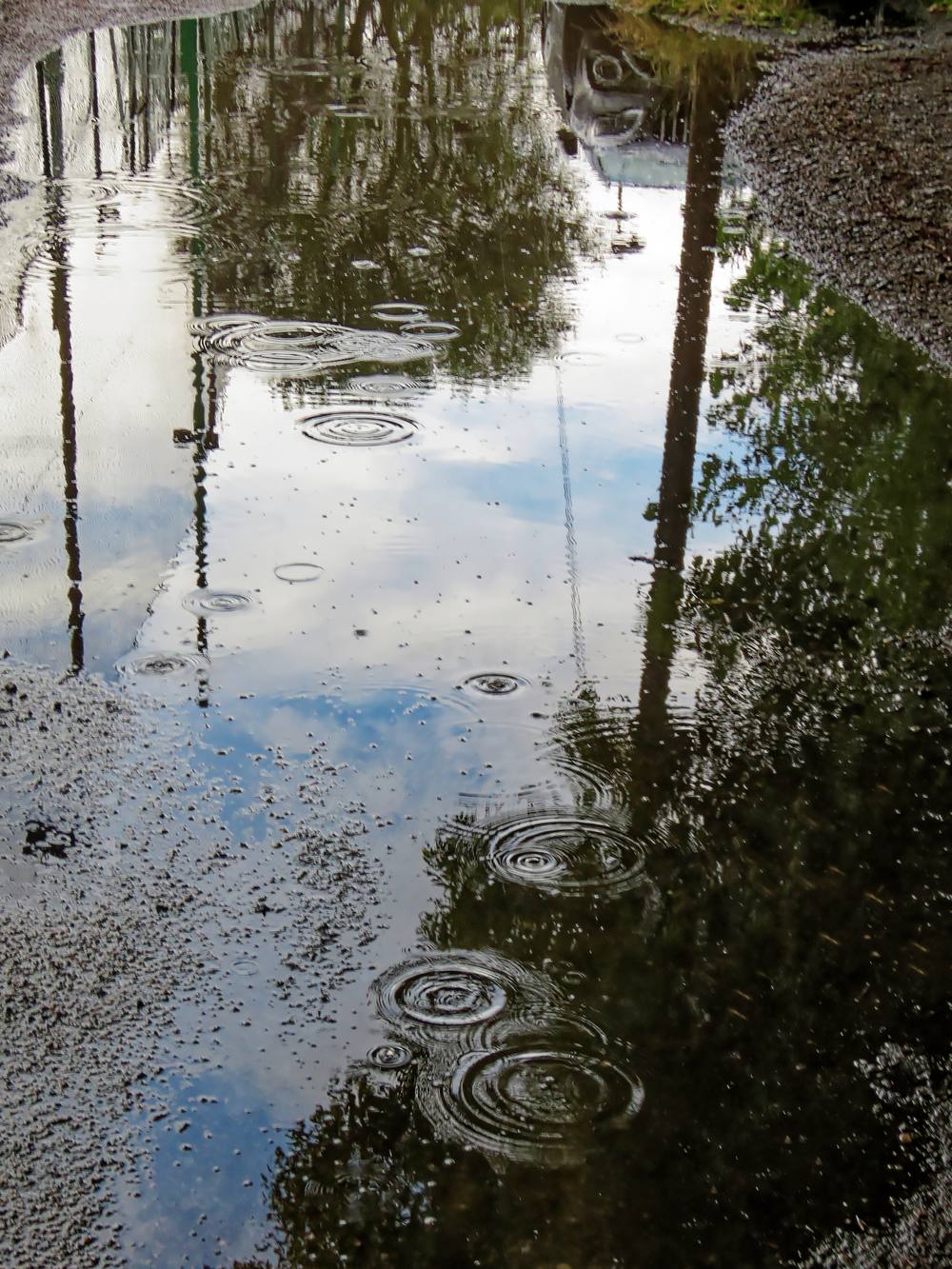
After the shower, the sky is in the puddle.
Photo: Acabashi (Wikimedia Commons, CC BY-SA 4.0)
Shonen Jidai
If “Sayonara Natsu no Hi” is a teenager’s rain shower, there is a Japanese song about a much younger summer, and almost everyone here knows it.
Yosui Inoue’s “Shonen Jidai” — written for the 1990 film of the same name, directed by Masahiro Shinoda and based on Fujiko Fujio A’s autobiographical manga.
One man, one guitar, one summer holiday.
“Shonen Jidai” — Yosui Inoue (1990)
Summer wasn't over yet.
Photo: nanamori (Wikimedia Commons, CC BY 3.0)
The person who finally gave that 1991 song a picture
had already drawn another story you have seen.
nina, and Racing into the Night
The animator is nina — a graduate of Tokyo University of the Arts whose name became widely known through the video for YOASOBI’s “Yoru ni Kakeru” (“Racing into the Night,” 2019).
She has since animated videos for Macaroni Enpitsu and the Japanese version for Olivia Rodrigo’s “drivers license,” and published a first collection of her work.
The same hand that drew a 1991 rain shower also drew that night.
“Yoru ni Kakeru” — YOASOBI (2019)
Mariya Takeuchi, and Station
Tatsuro Yamashita’s partner is Mariya Takeuchi — a songwriter who writes in her own words and sings them herself. If the name is new to you, the next chapter will not be.
One of her best-known songs is “Eki” (“Station”). She wrote it in 1987 for Akina Nakamori, then recorded her own version of it.
“Eki” — Mariya Takeuchi, souvenir 2000
Plastic Love
Here is the song you almost certainly already know. And here is the part that is easy to miss: on this live recording of “Plastic Love,” the first name in the musician credits is Tatsuro Yamashita, on guitar.
The man who wrote a song about the end of summer is standing behind his wife’s song about the night, playing rhythm.
“Plastic Love” feat. Tatsuro Yamashita — souvenir 2000
Asked in 2024 why a forty-year-old song had been picked up abroad, Mariya Takeuchi said she and her husband have talked it over and have no answer for it. The people who made it are as surprised as anyone.
A pier at dusk — the colour of a summer ending.
Photo: Estrategy (Wikimedia Commons, CC BY-SA 3.0)
HYBS and Tip Toe
The thread does not stop in Japan. Whatever it was that travelled out of those records, young musicians across Asia are working in the same air.
HYBS, from Thailand — James Alyn Wee and Karn Kasidej, a duo that disbanded in 2024.
“Tip Toe” walks through a city at night on the balls of its feet: a low, easy groove and a video that looks like an old television broadcast.
We are not claiming they were listening to Tatsuro Yamashita. Only that the stage — a city, after dark — is the same one.
“Tip Toe” — HYBS (2023)

Photo: MaedaAkihiko (Wikimedia Commons, CC BY-SA 4.0)
This summer, too,
is almost over.
From a rain shower in Tokyo to a night in Bangkok — the thread is still running.
Summer is almost over. Again.
NEXT STORY
This is not the only Japanese song about summer ending.
 A summer that crossed the seaThe summer of 1980 is not over.Seiko Matsuda’s “Blue Lagoon” — a 46-year-old Japanese summer song, sung back by a crowd born long after it. (Japanese edition)
 One more, for the end of summerA song goes home.Fujifabric’s “Wakamono no Subete” — the last-fireworks song, returning to the town it was written in. (Japanese edition)